AI Receptionist for Plumbers — Capture Every Emergency Callout, 24/7
Plumbing calls don't wait for you to climb out from under a sink. A burst pipe at 2am, a hot water system that dies on a Sunday, a sewer backing up during a family lunch: the plumber who answers gets the job. Steve answers those calls in a natural Australian voice, works out how urgent they are, gets the caller to turn the mains off, takes the address and access details, and texts the job to your on-call plumber as soon as the call ends.
No obligation · Niel calls you to book a time
Quick Answer
What does an AI receptionist do for a plumber? It answers every call you can't, including at night and on weekends, and sorts real emergencies (burst pipes, gas smells, sewer overflows, leaking hot water tanks) from work that can wait. Emergencies are texted to your on-call plumber with the address and access notes straight away; the rest is booked in.
Aussie AI Agency builds it for you, fully customised to your call-out fee, service area and on-call roster. It's live within 3 business days, from $149/month month-to-month. It never gives DIY advice or quotes a job total. Book a free 30-minute demo to hear it handle a plumbing call.
Still deciding between a call centre and AI? Our answering service guide for plumbers and electricians covers what tradies actually need from one.
Hear it handle real calls, then get one built for your business
Press play to hear our AI receptionist on real calls. Then tell us about your business and we'll build a free demo receptionist that answers in your business name.
Prefer a person? Speak to a human: 0417 460 236 or hear our AI now: Call Steve (AI): 03 4328 3434
Don’t take our word for it. Press play.
Press play to hear a real call · call 1 of 6
A caravan quote, with a call-back time
Caravan sales · quote request · 0:00 / 1:44
Listen for: it can't answer the technical questions, so it says so and books the expert to call back at four.
Real recordings with real callers, shared with permission by businesses we've built AI receptionists for. Some of these businesses are connected to the people behind Aussie AI Agency. To protect privacy, we've deliberately cut out names, phone numbers, emails and business names, and trimmed the calls for length.
Six plumbing calls, and exactly what happens on each
These are the calls Australian plumbing businesses tell us they miss most. Each one is handled by your own rules: what counts as an emergency, who is on call, and what you charge to come out.
| The call | What Steve does | What you get |
|---|---|---|
| 11:40pm, Saturday: "A flexi hose under the kitchen sink has split and there's water everywhere." | Marks it an emergency, asks whether the water is still running and whether they've been able to turn it off at the meter (your script, not DIY advice), then takes the address, access and a callback number. | An SMS to your on-call plumber within seconds: job type, suburb, water still running yes/no, access notes. Email copy to the office with the recording. |
| Sunday morning: "No hot water. It's a gas storage unit, maybe 12 years old." | Asks your hot water questions: gas, electric, solar or heat pump; leaking from the tank or relief valve, or just cold; any hot water at all. A leaking tank is flagged urgent. | A booked slot (or an urgent flag) with the system type and age already noted, so the right replacement unit goes on the van. |
| "The drain in the backyard is overflowing and it smells like sewage." | Treats a sewer overflow as urgent, asks if it's coming from the overflow gully outside or inside the house, and whether the property is a house, unit or strata. | A high-priority job with the overflow location and property type, ready for whoever has the jetter. |
| Property manager, 9:15am: "Work order for a dripping tap at a tenanted unit in Coorparoo." | Takes the agency name, work order number, tenant name and number, and any approval limit, then offers the next routine slot. | A clean work-order summary to copy into your job management system, with the tenant's contact for access. |
| "I can smell gas near the meter." | Reads your gas-smell script straight away (get everyone outside, no switches, call the gas distributor's faults line or 000) and does not book it as a normal job. | An immediate alert so your gasfitter can follow up once the caller is safe. |
| "How much do you charge to come out?" | Gives your call-out fee and after-hours rate exactly as you wrote them, explains the plumber will quote the job on site, and never guesses a total. | A booked job from a caller who already knows the call-out fee, so fewer surprises at the door. |
What makes plumbing calls different
Emergency vs scheduled, by your rules
You decide what counts as urgent: running water, sewage inside, no water at all, gas. Everything else (dripping taps, slow drains, toilet cisterns, quotes for bathroom work) goes into the next routine slot instead of waking your on-call plumber.
Rental, strata and insurance work
Steve captures the details agencies and insurers ask for: work order or claim number, owner vs tenant, strata manager, approval limit and access. Insurance make-safe calls are flagged so they don't wait behind routine jobs.
Storm season and heatwave spikes
When a storm hits, everyone rings at once. Steve answers several calls at the same time, so a flooded laundry in one suburb doesn't send the next caller to voicemail and a competitor. How call overflow works
Licensing stays with your plumbers
Steve never diagnoses, gives DIY repair steps or certifies work. Compliance certificates, backflow testing and gas work sit with your licensed staff; Steve books them and passes the details on.
Scenarios are illustrative composites based on common plumbing call patterns, not individual customer calls.
Why Australian plumbers structurally lose emergency callouts to voicemail
Mark runs a 6-van plumbing business out of Annerley, southern Brisbane. His team handles emergency callouts, hot water replacements, blocked drains, and bathroom renovations across Annerley, Indooroopilly, Sandgate and the inner-south. His Google Ads run 24/7 because that's when emergencies happen — burst pipes at 2am, hot water systems failing on Sunday morning, blocked sewers during Saturday family lunches.
The problem: Mark's office staff knock off at 5pm, and his on-call plumber can't safely answer the phone while elbow-deep under a kitchen sink in Indooroopilly.
Mark did the maths. An emergency callout fee is $220 minimum in Brisbane, with the average emergency job billing $450–$1,200 once parts and labour are settled. A hot water replacement is $1,800–$3,500. Storm-season blocked drains (Brisbane has a serious storm season Nov–April) regularly run $600–$2,000.
Mark estimated he was losing 8–15 calls per week to voicemail outside business hours. Even at a conservative $400 average job and 40% conversion, that was $1,300–$2,400 in lost revenue per week — and that's not counting the loyal customers he was annoying when calls went unanswered.
He onboarded Steve from Aussie AI Agency in 3 business days. Steve now answers every call 24/7. He triages the job type, asks for address and access, texts emergencies straight to the on-call plumber, and books non-urgent work into the standard booking queue. Email summary to Mark. SMS to customer with the plumber's name, ETA, and call-out fee disclosure. SMS to the on-call plumber with address, job type, customer name, and access notes.
Mark says the difference is brutal in a good way. He used to wake up Monday morning to 11 voicemails and a handful of angry text messages from customers who'd given up and called a competitor. Now he wakes up to a full Monday already booked solid by Sunday night, with his on-call plumber having handled the genuine after-hours emergencies in real time.
Mark's story is an illustrative composite based on common patterns observed across Australian plumbing businesses. No individual plumber is depicted. Real named AAA customers with permission to publish include Line Marking Australia and Dinar Exchange. Steve does not provide plumbing advice or quote regulated work — he triages and books only.
See Steve handle a 2am burst pipe call
Steve handles a 2am burst pipe — gets the mains turned off, captures the address, and texts the job to the on-call plumber. Full transcript below.
Read full transcript — 2am Camp Hill burst pipe
Customer (2:14am, panicked): “Mate, water everywhere — pipe burst in the laundry, I can't find the tap to turn it off.”
Steve: “Right, first thing — your water meter is usually at the front of your property, near the kerb. There's a tap on top, turn it clockwise to stop water to the whole house. Where are you located?”
Customer: “Camp Hill, 4152. I'm running outside now.”
Steve: “Good. While you do that, what's your full address?”
Customer: “47 Wynyard Street, Camp Hill.”
Steve: “Got it. Name?”
Customer: “Tom Reynolds. Got the tap off now, water's stopped.”
Steve: “Well done. I'm booking our on-call plumber to you now. Standard after-hours callout fee is $220 plus any parts and labour. Our plumber will give you a written quote on arrival before any work starts. Are you happy to proceed on that basis?”
Customer: “Yes, just send someone please.”
Steve: “Booking now. Our plumber Jason is on call tonight — ETA 45 to 60 minutes from Annerley. You'll get an SMS confirmation with his details in the next minute. Anything else I should let him know about the property — locked gates, dogs, access notes?”
Customer: “No, just come straight up the drive.”
Steve: “Easy. Jason will be there inside the hour. Stay safe.”
As soon as the call ends, Jason receives an SMS: “URGENT — Burst pipe, mains shut off. Tom Reynolds, 47 Wynyard Street, Camp Hill 4152, mobile on file. ETA committed 45–60 min. Straight up drive, no dogs. $220 callout disclosed, written quote on arrival.”
What happens on a plumbing call, step by step
- Customer calls your business number — your existing line, no change for customers.
- Steve answers within 2 rings — natural Australian voice, configured with your business name.
- Steve triages — emergency vs scheduled, burst pipe / blocked drain / hot water / gas / leak / general / quote-only.
- Steve captures — full address, access notes, customer name, callback number, severity, tenant vs landlord, isolation valves tried.
- Steve books — emergencies straight to your on-call plumber, non-urgent work into your calendar or booking queue.
- Steve notifies — as soon as the call ends — email summary to owner + SMS to on-call plumber + SMS confirmation to customer with plumber name, ETA and callout-fee disclosure.
Why plumbers need a specialised AI receptionist
Plumbing is 24/7 — but your phone isn't
Plumbing emergencies don't keep business hours. Burst pipes happen at 2am. Hot water systems fail on Christmas morning. Sewers back up during Saturday lunch when 12 family members are in the house. The plumber who answers wins the job. The plumber whose voicemail picks up loses it — usually permanently, because emergency customers don't call back, they call the next number on Google.
Yet most Australian plumbing businesses run their phones one of three broken ways:
- Office staff during business hours, voicemail after-hours. Loses every after-hours emergency, which is exactly when burst pipes and sewer blockages don't stop.
- Owner's mobile diverted after-hours. The owner answers from bed, half-asleep, and either books the job badly or sends the call to voicemail because they're driving / showering / asleep.
- Generic answering service. Captures a name and number but gives the customer no confidence the job is actually booked. Customer hangs up and calls the next plumber.
Steve breaks the pattern. He sounds like a real receptionist. He captures every detail. He books the job in real time. The customer hangs up knowing a plumber is on the way. If nights and weekends are your only gap, you can run him as an after-hours answering service for emergency calls and keep answering yourself during the day.
Your on-call plumber should be plumbing, not answering phones
When your on-call plumber is mid-job under a sink in Sandgate and the phone rings, one of two bad things happens:
- They take the call. They write the address on the back of their hand. The current job slips. The new call's details are forgotten or wrong.
- They don't take the call. It goes to voicemail. The new job is lost.
Steve solves this by being the receptionist your on-call plumber needs. While they're working, Steve takes the call, triages, books the job, and texts the plumber the details. The plumber finishes the current job, checks their phone, sees a fully-booked next job with address and access notes, and drives there. No paper. No half-remembered addresses. No lost callbacks.
The job dispatch difference
Generic answering services capture name and number. Steve captures everything you actually need to dispatch:
- Property type — house / apartment / commercial / strata
- Suburb and full street address
- Plumbing issue — burst pipe / blocked drain / hot water / gas / leak / new install / quote-only
- Severity — water actively flowing / contained / inconvenient but not urgent
- Access — front door / side gate / lockbox / strata access codes / dogs
- Customer name and best callback mobile
- Whether the customer has tried isolation valves / mains tap
- Whether this is a tenanted property (landlord vs tenant authority for spend)
That's the dispatch brief your plumber needs. Steve captures it on every call. Every time.
Licensed-trade boundaries (honest)
Plumbing is a regulated trade in Australia. Steve respects the boundaries that come with that.
1. Steve never gives plumbing advice
He may suggest the obvious safety action (“the water meter is usually near the kerb at the front — turn it clockwise to shut off water”). He does not diagnose, explain regulated work, recommend products, or talk a customer through DIY repair. Anything beyond stopping water flow / gas flow gets routed to a licensed plumber.
2. Steve never quotes regulated work over the phone
Plumbing pricing involves site assessment, parts, complexity, and licensing requirements. Steve quotes your published call-out fee (“our after-hours call-out is $220, plus parts and labour, with a written quote before work starts”) and nothing else. No estimated job totals over the phone. Ever.
3. Steve never holds himself out as a licensed plumber
Steve is a receptionist. He books licensed plumbers to attend. If a customer asks “are you the plumber?” — Steve says: “No, I'm the booking line. I'll have a licensed plumber to you in [X] minutes.”
4. Steve respects gas-fitting separation
Gas work is a separately licensed scope from general plumbing. If a customer mentions gas leak, gas smell, or any gas-related emergency, Steve treats it as high-priority safety — advises immediate evacuation if a strong gas smell is reported, advises calling 000 if there's any risk to life, and dispatches your on-call gas-fitter (or routes to your emergency gas line) immediately.
5. Steve handles regulator-mandated disclosures
Plumbing is regulated state-by-state in Australia:
- Queensland: Queensland Building and Construction Commission (QBCC)
- Victoria: Victorian Building Authority (VBA)
- NSW: NSW Fair Trading — Plumbing, Drainage and Gasfitting
- Western Australia: Building and Energy WA
- Tasmania: CBOS Tasmania — Plumbing
Steve quotes your licence number on request and points customers to the relevant regulator's “find a plumber” register if they want to verify.
6. Steve handles strata and tenanted properties correctly
For tenanted properties, Steve confirms whether the caller is the tenant (in which case authority for non-emergency spend requires the landlord/agent) or the landlord/agent. For strata, Steve flags whether the issue is potentially common-property (which affects who's authorising and paying). These aren't legal opinions — they're booking-level facts your plumber needs before quoting.
Does it work with ServiceM8, Tradify or AroFlo?
Google Calendar booking is built in. For plumbing job management software such as ServiceM8, Tradify, AroFlo, simPRO or Fergus, Steve works alongside it: your team adds each job from the details he sends, and a direct integration is quoted on request.
Nothing depends on an integration on day one. Every job is texted to the plumber who needs it and emailed to the office with the recording and transcript, so an owner-operator running jobs from a phone and a notebook gets the same dispatch brief as a six-van business.
Pricing — straight-up
| Plan | Best for | Monthly |
|---|---|---|
| Starter | Owner-operators, 1–3 vans (100 voice min + 50 SMS) | $149 |
| Business | 4–10 van operations, after-hours emergency volume (250 voice min) | $299 |
| Growth | 700 voice minutes + 400 SMS — high-volume teams | $499 |
| Enterprise | 10+ van operations, multi-location, custom dispatch | from $1,299 |
Every plan answers 24/7, texts and emails you each job, and is configured around your call-out fee and emergency rules. Plans are ex GST and month-to-month. Extra minutes beyond your plan are $0.85/min on Starter, $0.65 on Business, $0.45 on Growth and $0.29 on Enterprise, capped at the gap to the next plan up, so a wet winter week can't blow out your bill.
No money-back guarantee — but a free 30-minute demo with Niel first, so you can see exactly how it would work before you commit. See full pricing on the pricing page.
When Steve is not right for your plumbing business
We will tell you straight: Steve is not the right fit if —
- You do less than 5 calls a week (voicemail is fine; Steve's ROI doesn't stack up)
- You're a solo plumber who genuinely enjoys answering the phone and doesn't want to delegate
- Your customer base is 90% repeat work and they all have your direct mobile
- Your work is 100% commercial contract with no after-hours emergency demand
If any of these apply, save your money. We'd rather you not sign up than churn out.
Related pages for trades
- AI Receptionist for Tradies — the parent hub covering all Australian trades
- AI Receptionist for Electricians — sibling page for licensed sparkies
- AI Receptionist for Cleaners
- After-hours answering service — emergency calls answered nights and weekends
- Pricing & plans
After every call, the message is in your pocket
Seconds after a call ends you get a text and an email: who rang, what they want, how urgent it is and when to ring them back. Urgent calls can come straight through to you.
- No more listening to voicemails
- Every caller's name, number and reason
- Call back the right people first
Text message · just now
Email · call summary
- Caller
- Steve
- Wants
- Quote, Somerset 17
- Call back
- Today, 4pm
- Urgency
- Normal
Example based on the caravan call above.
Manage every call from your dashboard
Every call lands in your own dashboard: who rang, what they need and what to do next. Tap Done, assign it to someone or add a note. Add as many staff as you like, there’s no limit.
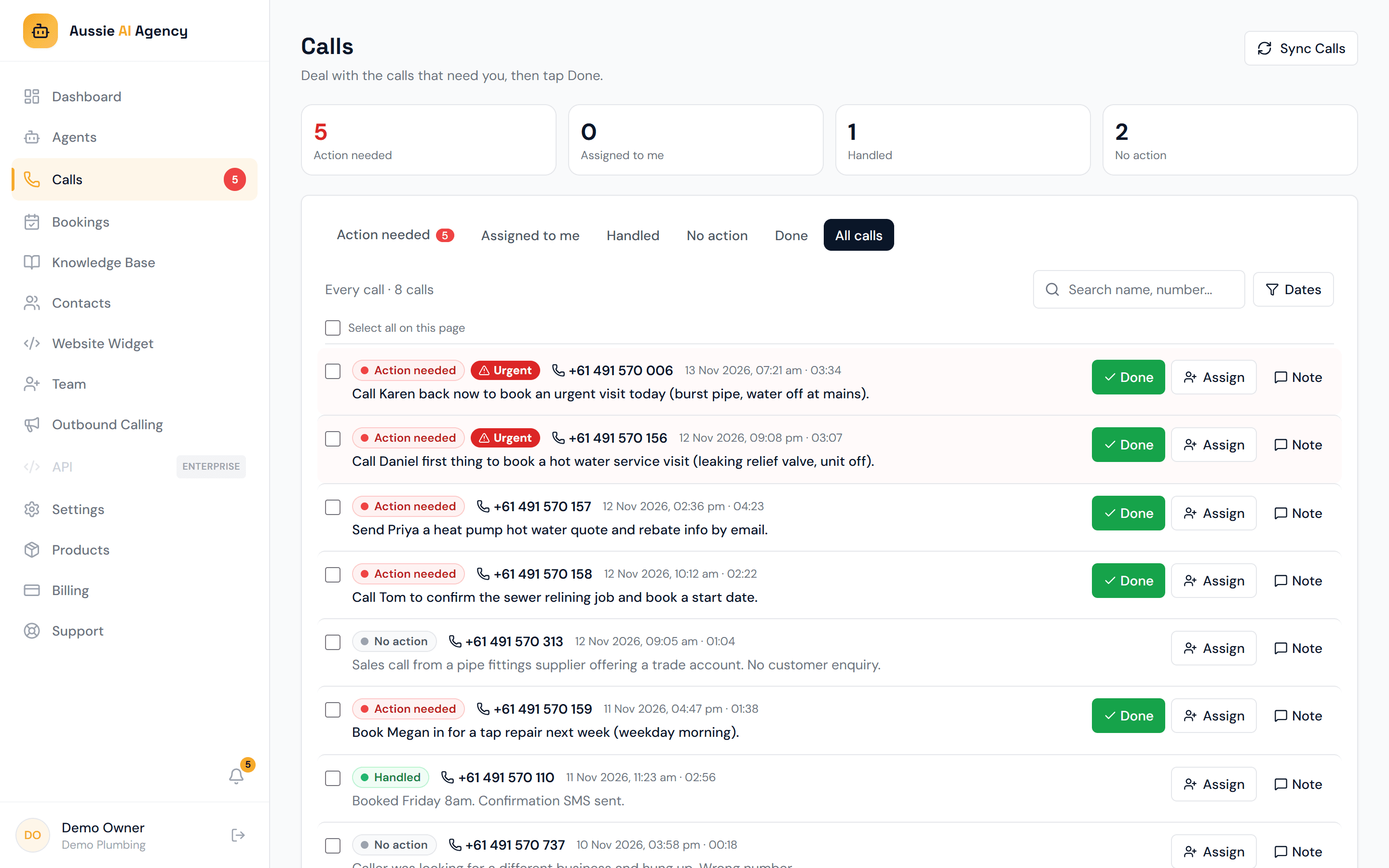
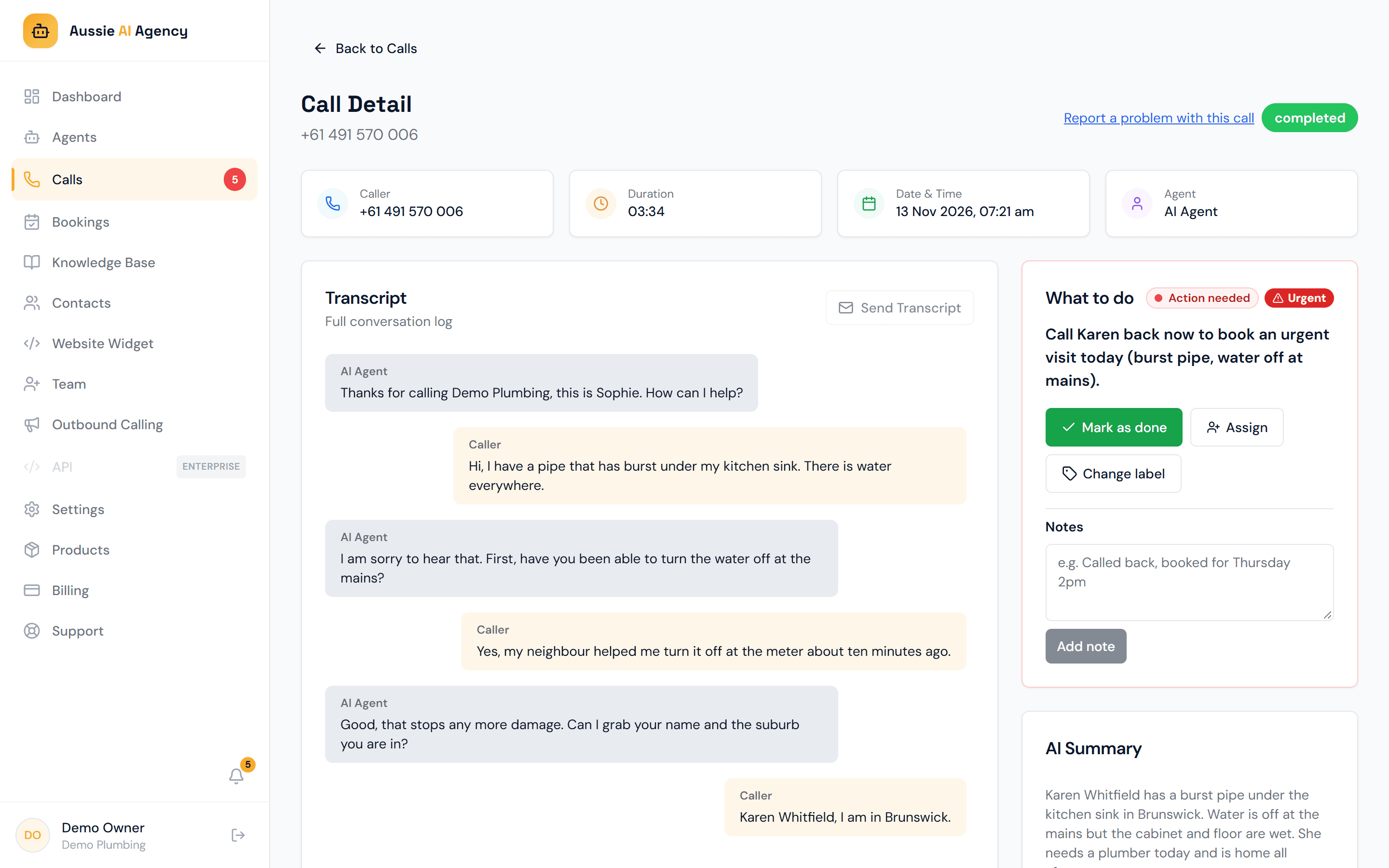
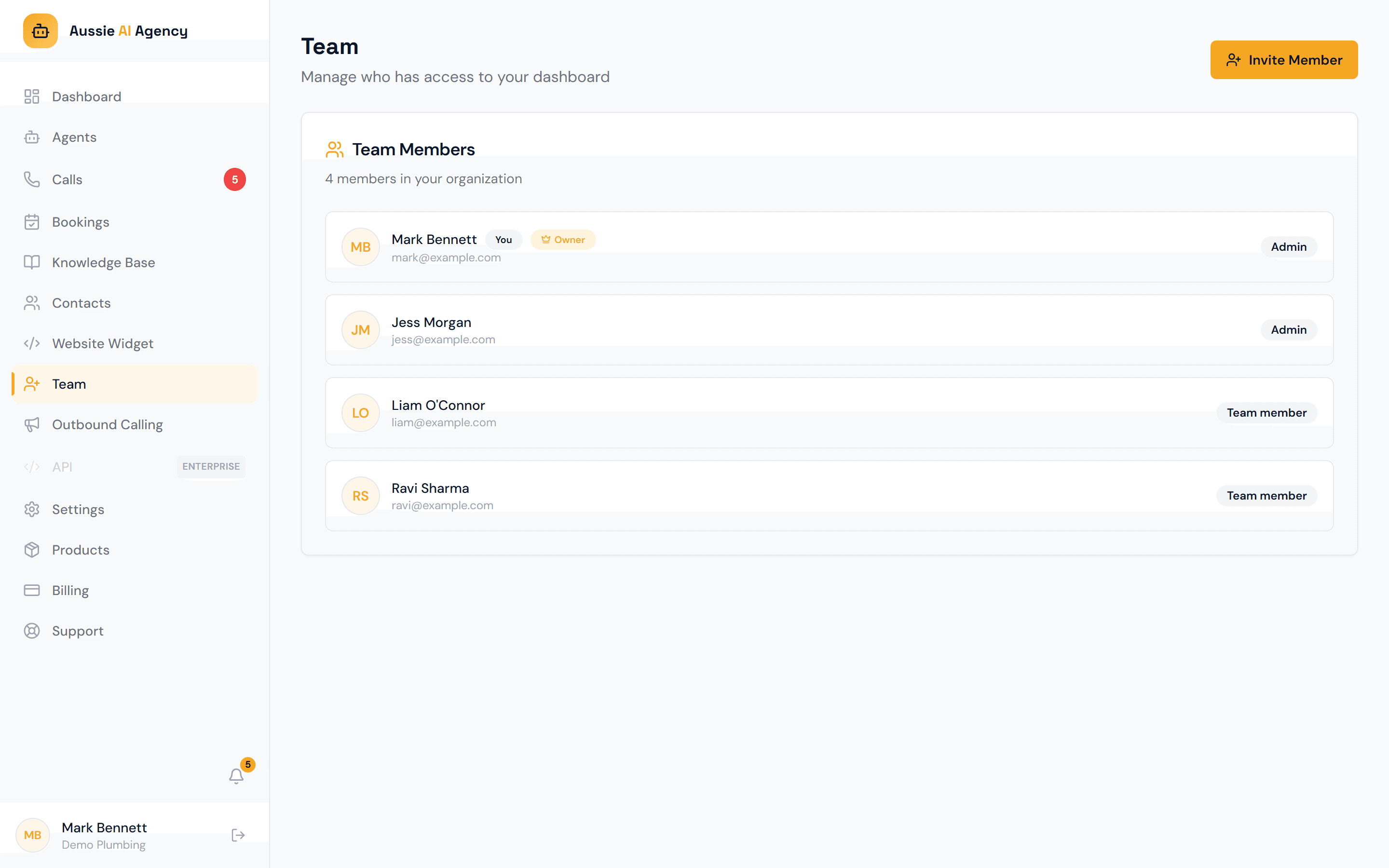
Example dashboard with sample data.
Real customer
Hear it from a plumber who uses it
He’s on the tools all day, so his AI receptionist answers the calls he can’t. Here’s what he thinks, in his own words.
Get my free demoRelated Services
Common questions about AI receptionists for plumbers
Quick Facts: AI Receptionist for Australian Plumbers
- Best fit:
- Plumbing businesses with 1+ van and after-hours emergency demand
- NOT a fit:
- <5 calls/week, solo plumbers who love phones, 100% commercial contract with no emergency demand
- Emergency response:
- Triage on the call, SMS to the on-call plumber as soon as it ends
- Licensed-trade boundaries:
- No DIY advice, no quote on regulated work, no holding-out as licensed
- Gas-fitting handling:
- 000 escalation if life risk, otherwise immediate gas-fitter dispatch
- Regulator awareness:
- QBCC (QLD), VBA (Victoria), NSW Fair Trading, Building and Energy WA, CBOS Tasmania
- Booking systems:
- Google Calendar built in; works alongside other job management software (direct integration quoted on request)
- Pricing:
- $149 / $299 / $499 / from $1,299 per month (ex GST) — book a free 30-minute demo with Niel
- Setup time:
- Live within 3 business days, then up to 2 weeks of fine-tuning on real calls
- Security & privacy:
- Encrypted in transit and at rest, Privacy Act 1988 + NDB aligned, ISO 27001 framework-aligned (certification on roadmap), caller data never sold
- Author:
- Niel Bennet, Founder of Aussie AI Agency
Sources: QBCC, VBA, NSW Fair Trading, Master Plumbers Australia, Plumbing Code of Australia (NCC Volume 3), WaterMark Certification Scheme, 2026.
Ready to stop losing emergency callouts to voicemail?
Book a free 30-minute demo with Niel. Live in 3 business days, from $149/month, month-to-month. Cancel any time.
No obligation · Niel calls you to book a time
Live within 3 business days.
Or speak to a human: 0417 460 236 · Email info@aussieaiagency.com.au
Sources & disclosures
State plumbing regulators:
- Queensland Building and Construction Commission (QBCC)
- Victorian Building Authority (VBA)
- NSW Fair Trading — Plumbing, Drainage and Gasfitting
- Building and Energy WA
- CBOS Tasmania — Plumbing
Industry association & codes:
- Master Plumbers Australia
- Australian Building Codes Board — National Construction Code (Plumbing Code, Volume 3)
- WaterMark Certification Scheme
Privacy & consumer protection:
Real customer references: Line Marking Australia and Dinar Exchange with permission. Mark's Annerley story is an illustrative composite based on common patterns across Australian plumbing business clients. No individual plumber is depicted.
Composite disclosure: The 6-van Annerley story, the 2am Camp Hill burst-pipe transcript, the callout-fee figures ($220) and average job values ($450–$1,200 emergency, $1,800–$3,500 hot water, $600–$2,000 storm-season drains) reflect typical patterns we observe across Australian plumbing clients. Individual business results vary by location, on-call coverage and service mix.
Pricing and hours are accurate at publish date and may change. Steve does not provide plumbing advice, hold a plumbing licence, or quote regulated plumbing work. Aussie AI Agency is not affiliated with QBCC, VBA, NSW Fair Trading, Building and Energy WA, CBOS Tasmania, or any other state plumbing regulator.
Security & data handling: Privacy Act 1988 (Cth) compliant. Encrypted in transit and at rest; caller data is never sold. Some service providers may process data overseas — see our privacy policy. Aligned with the 13 Australian Privacy Principles and the Notifiable Data Breaches (NDB) Scheme. ISO 27001 framework aligned (formal certification on roadmap).
Not legal, trade, or compliance advice. For specific compliance questions about plumbing licences, backflow certification, gas-fitting, or regulated work scope, consult Master Plumbers Australia, your state plumbing regulator, or specialist construction legal counsel.
Conflict of interest disclosure: Aussie AI Agency sells AI receptionist services. We benefit financially when readers become customers.
Aussie AI Agency · 240 Plenty Road, Bundoora VIC 3083 · ABN 44 772 398 737 · info@aussieaiagency.com.au · 0417 460 236